


It’s a misty morning at 6:00am in Boston. Hopefully the adverse weather translates to higher demand.
Here’s an Uber ride which is very similar to the Lyft ride I wrote about in a previous post. That one was 9.4 miles and this one is 9.23 miles. Both had tunnel tolls.
The upfront fare is $10.61. Unlike lift this number does not get obscured in fee calculations. Good for Uber. Also tolls are labeled as “Refunds” by Uber. Lyft labels tolls as “Earnings”. Not right. Misleading.
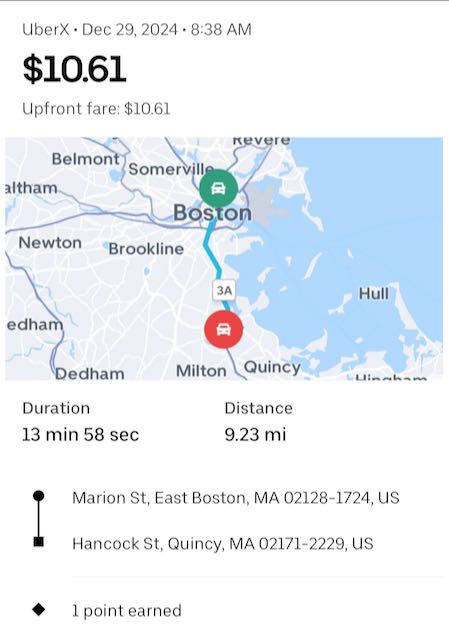
Rounding up the time and distance on this ride let’s call it 14 minutes and 9.25 miles. The Lyft ride was 19 minutes and 9.4 miles and it paid just $8.09 in upfront fare. This is terrible. This Uber ride pays 31% more and in 35% less time. That’s big.
The Trip Details for this ride correctly labels the tolls as a refund and adds it to what is labeled as “Trip balance”. That’s acceptable.
At the bottom of this graphic are some key timestamps. Timestamps for when the trip was accepted, when it began, and when it ended. The “En route” time is also included and this is used as a component of “engaged time”. Engaged time or booked time is included in the calculation to a minimum payout of $32.50 per hour.
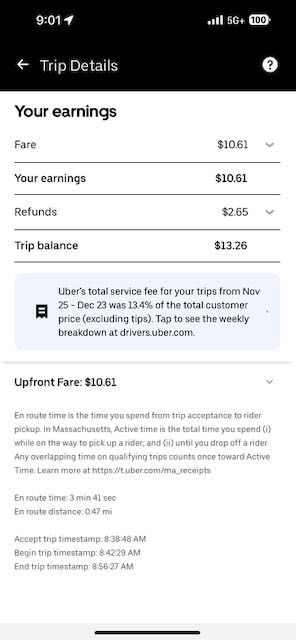
What’s missing from these mobile app screenshots are any numbers associated with what the customer pays and any fees that are deducted. To find that the driver has to login to his/her account via the web portal. The mobile app does not have this information.
Uber’s itemization of payments and expenses is pretty good and organized. First it shows the customer payment.
These next screenshots have been cropped to show just the numbers.
The Total customer fare includes the toll. Subtracting that out we have $22.02 – $2.65 = $19.37. Keep this in mind when considering time and distance rates.


This itemization is organized nicely and shows that Uber has $6.67 as their gross revenue. That’s about 34% of the $19.37 customer payment (less the toll).
The distance on this ride is 9.23 miles times the IRS expense rate of $.67 per mile and that equals $6.18 in expenses. Subtract that from the $10.61 of earnings for a net earning of $4.43. This ride was 14 minutes. If the driver could do 4 similar rides per hour the hourly rate the drier pockets would be $17.72. Still not good. Currently the rides per hour experienced by drivers is less that 3 per hour. Assuming the rides per hour rate is 2.75 that would work out to be $12.18 per hour. Hard to live with.
There’s always someone who says, “well it a gig, not a job. It’s not intended to be a job”. The fact of the matter is a very large percentage of drivers make this their full time source for income. Let’s not forget that “The Gig Economy” promised “Getting Better Work, Taking More Time Off, and Financing the Life You Want”.

Questions & Comparisons
We have two very similar rides. Both about the same distance but each with a different rate applied for time and distance. What are those rates? No one knows anymore. We’ll do some comparisons in another post.
Leave a Reply